


The UK’s energy system is mid-transition. Government targets call for clean power by 2030 and net zero greenhouse gas emissions by 2050. Behind those headline dates sits a sprawl of policies, delivery bodies and market mechanisms that shape what green energy services actually look like on the ground, from grid connections for new solar farms to the tariff a household signs up to. The roadmap is public. The friction is in the detail.
Grid connection delays and the Ofgem connections review
Most coverage of the UK’s green energy roadmap focuses on generation capacity: how many gigawatts of offshore wind, how much solar, how many nuclear reactors. Less discussed is the bottleneck that sits between a consented project and the moment it starts exporting electrons.
Further reading: Innovative marketing services transforming UK businesses
Grid connections have become a delivery problem serious enough to attract formal regulatory intervention. Ofgem’s 2025-26 connections review sets out work on clearer connection offers and stronger accountability for delays. The review also introduces a voluntary route for customers seeking earlier or alternative connections, including flexible or phased arrangements.
For green energy services providers, this matters directly. A solar farm or battery storage project that secures planning permission but waits years for a grid connection ties up capital and delays carbon savings. The review’s focus on consistent service standards and progress updates is an attempt to turn connection queues from an opaque waiting game into something closer to a managed process.
You may also like: UK courier services: The future of parcel delivery in 2026
Whether those measures translate into shorter timelines depends on investment in physical grid infrastructure, not just administrative reform. Transmission expansion remains a constraint that no amount of process improvement can fully resolve without new cables in the ground.
Household energy flexibility: who benefits from smart tariffs
The Clean Power 2030 Action Plan and the Clean Flexibility Roadmap both emphasise demand-side flexibility as a pillar of the future energy system. In practice, this means households shifting when they use electricity, responding to time-varying prices, charging electric vehicles overnight, or letting a battery discharge during peak hours.
The logic is sound. A grid powered largely by wind and solar produces electricity in patterns that do not match demand. Flexibility services help smooth the gap. The government’s vision positions consumer-led flexibility alongside large-scale battery storage as a route to a lower-cost, lower-carbon system.
The problem is access. A Which? review found that access to smart tariffs and flexibility offers varies significantly between households. People without suitable smart meters, prepayment customers and some storage-heater users face barriers. A tariff that requires shifting demand may not suit a household with limited ability to change when it uses electricity, whether because of health needs, caring responsibilities or simply the age of its appliances.
- Smart meter coverage remains uneven, and some older meter types do not support half-hourly settlement needed for time-of-use tariffs.
- Prepayment customers are often excluded from the most competitive flexible tariff offers, despite being among those who would benefit most from lower bills.
- Households reliant on storage heaters, common in parts of Scotland and rural England, may find their existing heating patterns incompatible with newer flexible pricing structures.
If the green energy roadmap depends partly on millions of households adjusting their consumption, the question of who can participate and who is left behind becomes a policy gap, not a footnote.
Heat network regulation under Ofgem from January 2026
Heat networks supply a growing share of low-carbon heating in British towns and cities, connecting blocks of flats and commercial premises to a shared heat source. Until recently, consumers on heat networks had fewer protections than gas or electricity customers.
That changed in January 2026, when statutory Ofgem regulation of heat networks across Great Britain went live. The new regime covers pricing, billing, cost recovery and consumer protection, according to Consumer Scotland’s 2025-26 annual report.
This is a quiet but significant shift for green energy services. Heat networks are expected to play a larger role in decarbonising buildings, particularly in dense urban areas where individual heat pumps are impractical. Statutory regulation gives consumers a formal complaints route and pricing oversight that did not previously exist.
What remains less clear is how the new rules will interact with the economics of building and expanding heat networks. Cost recovery provisions need to balance consumer protection against the capital investment required to extend networks to new developments. The regulatory framework is now in place, but its practical effect on network expansion will take several years to assess.
Clean power 2030: delivery risks beyond the targets
The UK government’s target of a clean power system by 2030 is backed by the Clean Power 2030 Action Plan and supported by mechanisms including Contracts for Difference (CfD) allocation rounds for renewable energy projects. Energy UK, the industry trade body, has called for maxing out CfD allocation rounds and moving faster on transmission infrastructure.
Several delivery risks sit beneath the target:
- Supply chain capacity for offshore wind components, particularly turbine blades and subsea cables, is stretched across Europe. UK projects compete with continental European programmes for the same manufacturing slots.
- Planning consent timescales for onshore infrastructure, including substations and overhead lines, remain a source of delay that sits outside Ofgem’s remit.
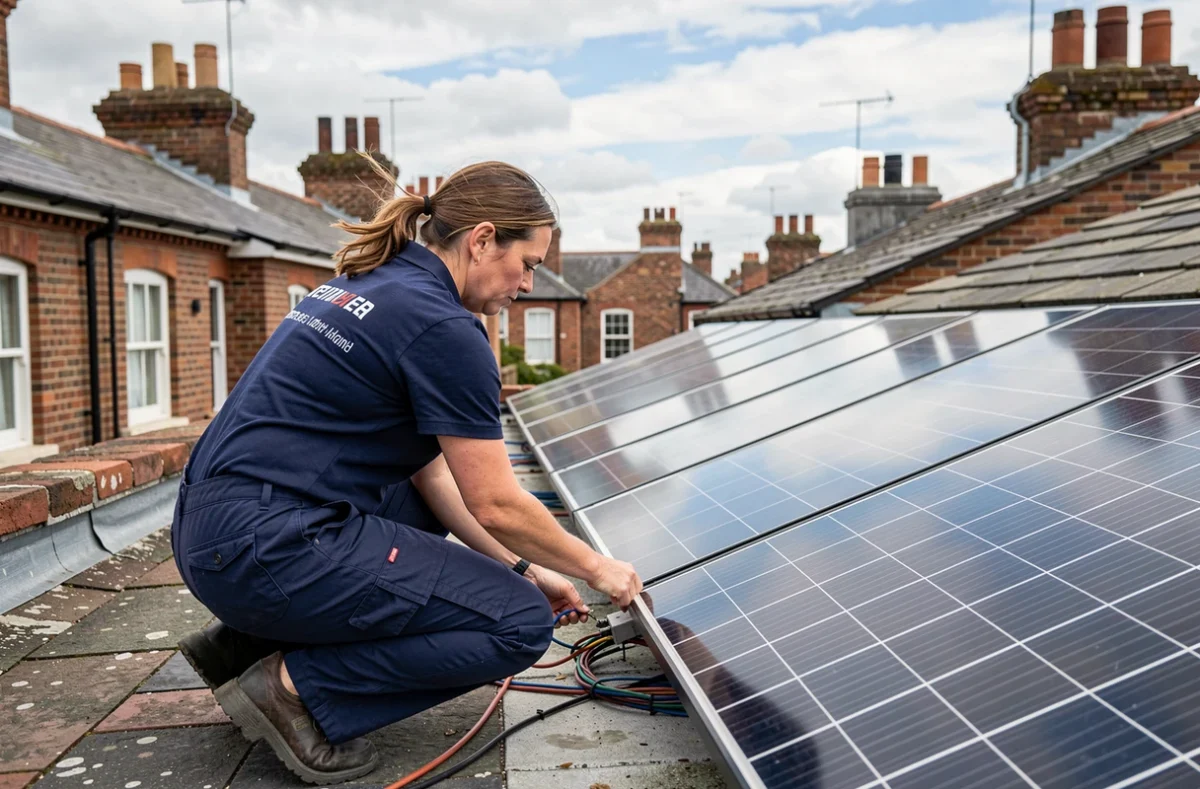
- Skills shortages in electrical engineering, cable jointing and project management affect both transmission operators and the smaller firms delivering rooftop solar and domestic heat pump installations.
The National Energy System Operator (NESO) and Ofgem are both involved in removing barriers to flexibility deployment, but the roadmap’s success depends on coordination across planning authorities, supply chains, training providers and private investors, none of whom answer to a single body.

What the green energy roadmap means for services on the ground
SP Energy Networks’ Sustainable Business Strategy targets net zero greenhouse gas emissions by 2035 for its own operations, covering central and southern Scotland, Merseyside, North and Mid Wales, Cheshire and North Shropshire. That kind of commitment from a distribution network operator signals that decarbonisation is not limited to generation; it reaches into the cables, substations and operational vehicles that keep the lights on.
For businesses and households navigating the transition, the practical landscape of green energy services is shaped less by the 2050 target and more by the regulatory and infrastructure decisions being made now. Connection timelines, tariff eligibility, heat network protections and CfD round outcomes are the mechanisms that determine whether a renewable project proceeds, whether a household benefits from flexible pricing, and whether a new development gets low-carbon heat.
The UK’s green energy roadmap is not a single document. It is a set of overlapping policies, regulatory reviews and market signals. The direction is clear. The pace depends on whether the machinery of delivery, grid infrastructure, consumer access, supply chains, keeps up with the ambition.